
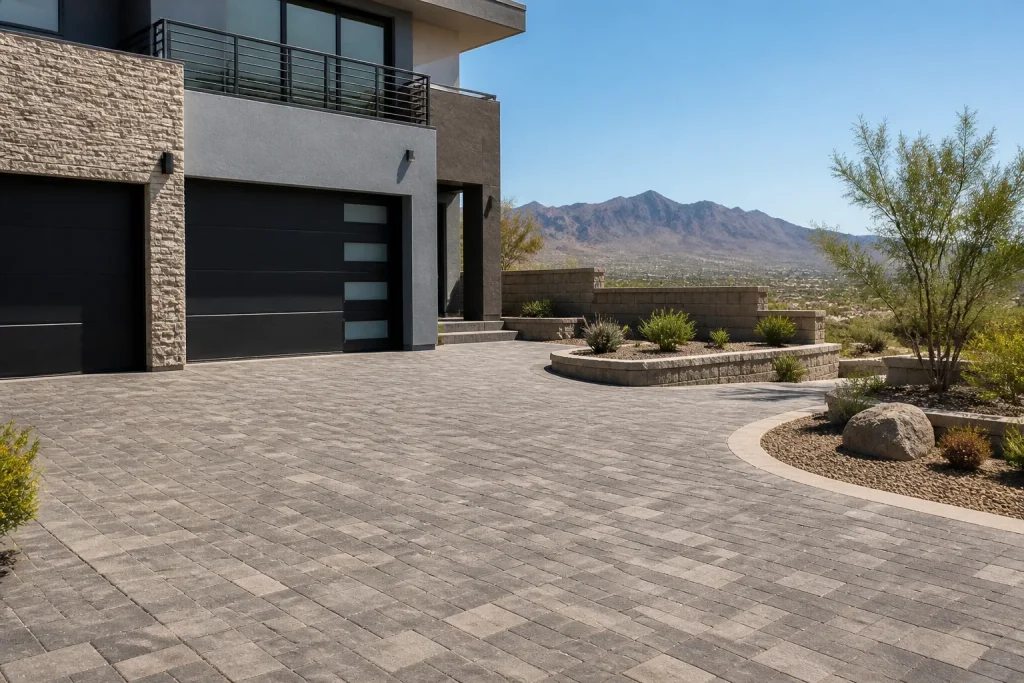
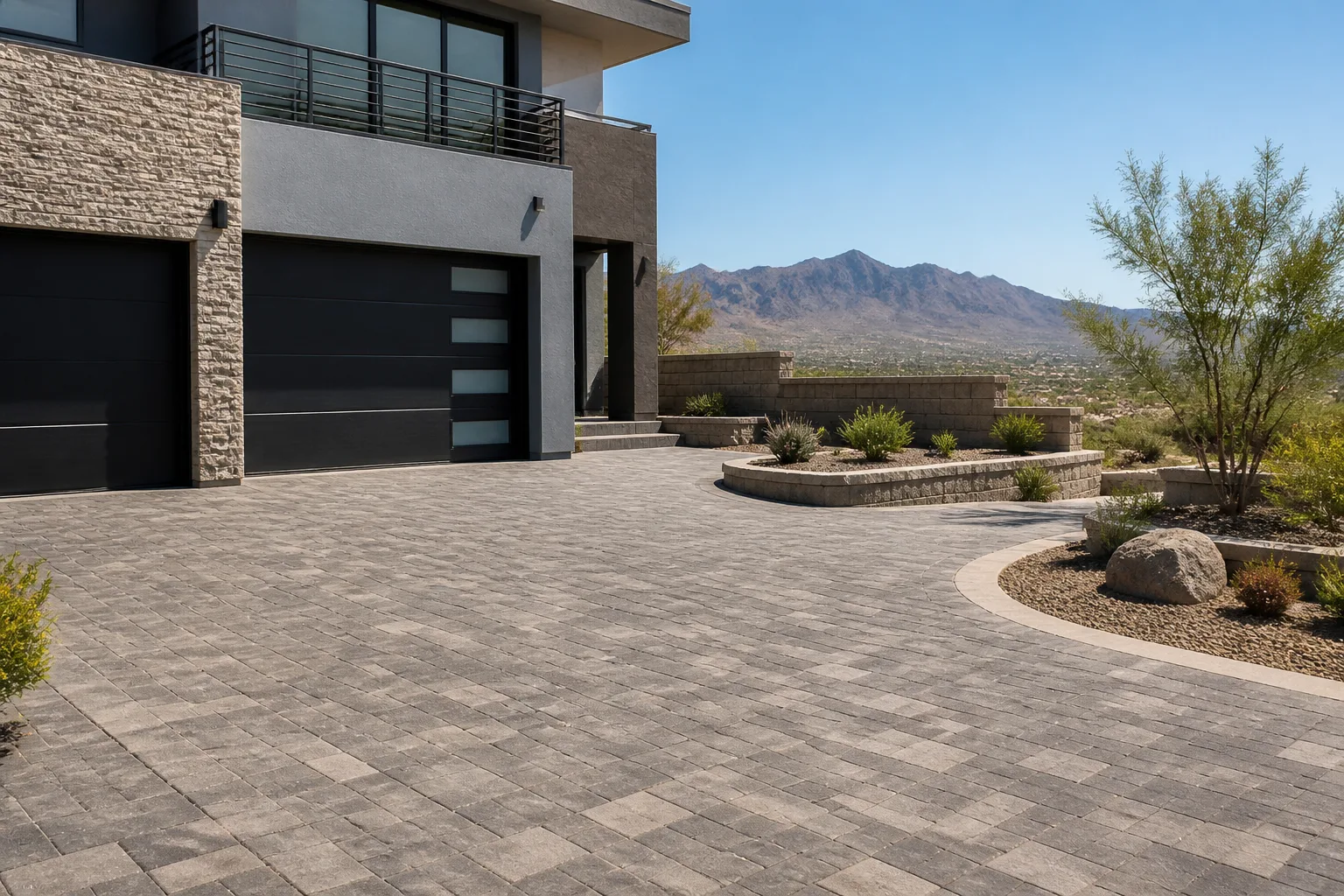
Techo-Bloc Driveway & Pavers in Las Vegas: A Homeowner’s Guide
Techo-Bloc was engineered and tested in Quebec, where the design challenge is freeze-thaw cycling through 0°F winters, not the sustained surface heat that can push a south-facing Las Vegas driveway past 160°F in July. The pavers still perform well here. But the reasons they perform well are not the reasons in the brochure, and the specs that matter most in Clark County are the ones a Canadian climate barely stresses: sealer reapplication, joint sand selection, and base depth under desert soil. This guide translates the manufacturer’s data sheet into Las Vegas decisions. If you’d rather hand the whole thing to someone who has already made those decisions a few hundred times, call (833) 467-9123.
How does Las Vegas heat treat Techo-Bloc pavers differently than a cold climate would?
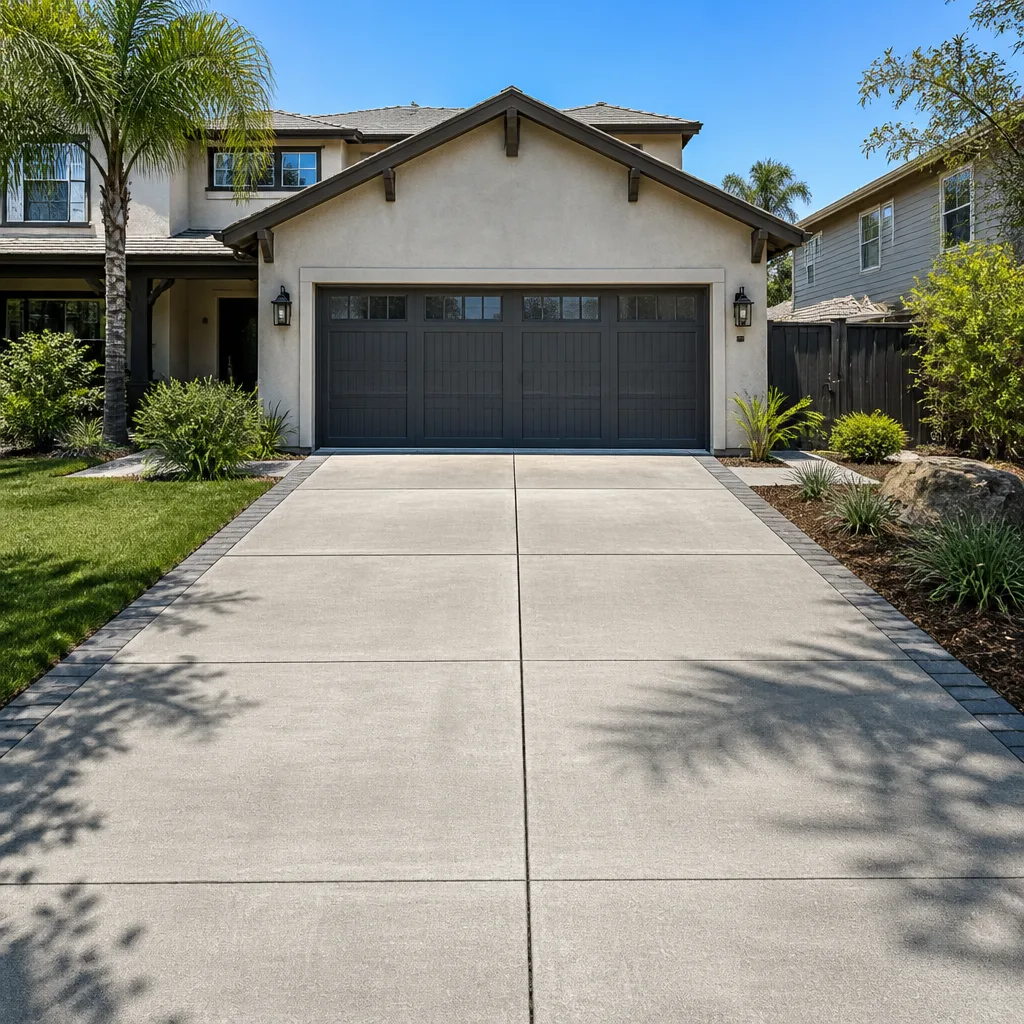
Heat, not frost, is the dominant stress on a Las Vegas paver installation. Techo-Bloc’s iCast process fuses a dense face layer onto a structural concrete body, and that face is what takes the UV load. In a Quebec winter, the enemy is water freezing inside the pores and expanding. In Las Vegas, the enemy is months of ultraviolet exposure at surface temperatures that climb well past the ambient air reading, followed by the thermal shock of a monsoon downpour that can drop pavement temperature 40°F in minutes.
What that means practically:
- Sealer life is shorter here. Expect a penetrating sealer to need reapplication every 2 – 3 years in Las Vegas, versus 4 – 5 years in cooler, wetter climates. Horizontal sun-exposed surfaces like a driveway go first; shaded patio pavers often hold twice as long.
- Color shift is real but slow. The iron oxide pigments Techo-Bloc uses are UV-stable, but the cement matrix around them lightens with solar exposure. A driveway in Summerlin that faces west will read noticeably lighter in five years than the sample board did, and that is normal, not a defect.
- Efflorescence appears fast and disappears slowly. The white mineral bloom that shows up on new concrete pavers is driven by moisture moving through the slab. In Las Vegas’s dry air it can linger for a full season instead of a few weeks.
We pulled a Raffinato walkway out of a garage in The Lakes last spring where the sealer had been applied once, at install, six years prior. The pavers were structurally sound. The surface was chalky and the joint sand was gone. That’s the typical Las Vegas failure mode: not broken pavers, neglected surface protection.
Which Techo-Bloc lines actually work for a Las Vegas driveway?
Not every Techo-Bloc paver is rated for vehicular traffic, and the product names don’t make that obvious. For a residential driveway in Las Vegas, three lines come up most often, each with a different job:
- Raffinato – a smooth-faced paver with a compressive strength in the high-PSI range (Techo-Bloc publishes it in the 8,000+ PSI class), suitable for driveways when installed at the manufacturer’s specified thickness. The clean face shows tire marks less than a textured paver and sweeps easily, which matters when your driveway is also your monsoon drainage path.
- Victorien – a textured, tumbled-edge paver with a similar structural rating, better slip resistance, and a look that reads closer to natural stone. Popular in the older, tree-lined neighborhoods around Rancho and Scotch 80s where a uniform modern slab would look out of place.
- Bristol Valley – a larger-format, textured paver. Fewer joints per square foot means less sand to lose and less opportunity for monsoon wash-out, but the larger units need a flatter base to sit without rocking, so base prep cost goes up.
On thickness: a residential driveway carrying passenger vehicles and the occasional delivery truck should be specified at the manufacturer’s full driveway thickness, not the pedestrian thickness used for a patio. Techo-Bloc’s technical data sheet lists the minimum for each product and application; anyone quoting a driveway at patio thickness is either guessing or cutting. We hold the data sheet to the spec, not to memory.
Why is polymeric sand selection more critical in Las Vegas than almost anywhere else?
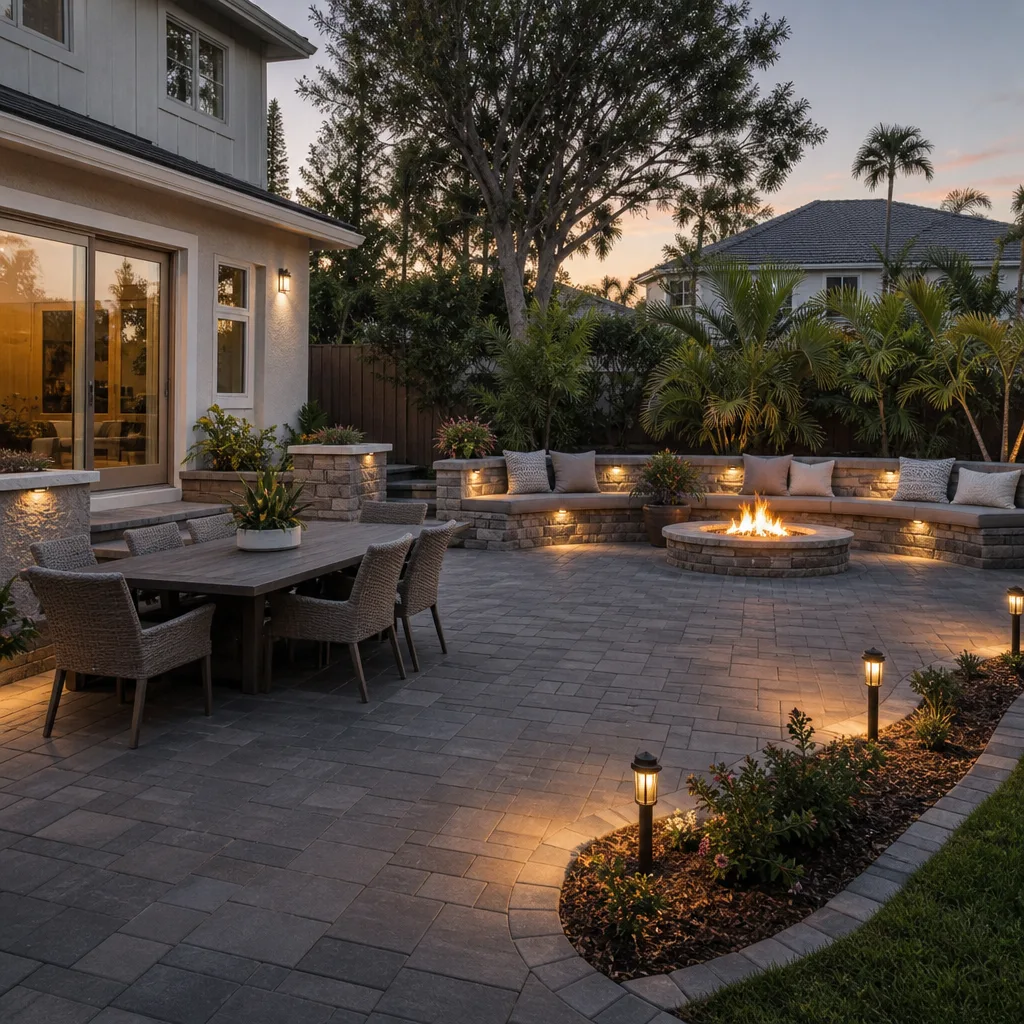
Because Las Vegas gives joint sand two opposite problems in the same year. A monsoon cell can drop an inch of rain in under an hour and push water across a driveway hard enough to scour joints. Then the desert sits dry and 110°F for weeks, baking whatever moisture is left and testing whether the binder in the sand actually cured or just skinned over.
What holds up here:
- A polymeric sand rated for wide joints and heavy water exposure. Techo-Bloc publishes compatible joint sand recommendations for its products; stick to those rather than whatever the supply house has on pallet. Brands in the Alliance and SRW families are the ones we see surviving Las Vegas monsoons. Bargain sand with a light polymer dusting washes out in one season.
- Correct joint width. Polymeric sand needs a joint wide enough to key into. Tight, buttered joints with barely a gap will shed the sand within a year no matter which brand you use.
- A full cure window before the first rain. Polymeric sand needs to set before it gets wet. In Las Vegas that usually means installing in the dry season and keeping a hose off it for the cure period the bag specifies.
And note: Techo-Bloc’s own guidance, and ours, is that joint sand is a maintenance item, not a one-time install step. Plan to top off joints every few years. A driveway that looks like it’s shedding sand after two monsoons is behaving normally; one that has lost its joints entirely in six months was installed wrong.
What base depth does Clark County expect under Techo-Bloc pavers?
Clark County inspectors typically expect a compacted aggregate base of about 4 inches for a residential driveway carrying passenger vehicles, with the paver bedding sand layer on top of that. That’s the number the inspection is built around, and it should be in the written scope before anyone breaks ground.
The interaction with Techo-Bloc’s bedding layer is where installers get casual. The base is structural; the bedding sand is a leveling course, not a support layer. If someone skimps on base and thickens the bedding sand to make up the difference, the driveway will rut and rock within a season, especially in Las Vegas where the native soil under a stripped lot can be caliche-hard in one spot and loose fill in the next.
What to look for in the scope:
- Excavation depth stated in inches, and the base material named (typically Class II aggregate base, compacted in lifts).
- Compaction confirmed with a plate compactor in lifts, not one pass at the end.
- Bedding sand layer thickness stated separately from base depth, so you can see neither was substituted for the other.
- Edge restraint specified. Techo-Bloc pavers need a fixed edge; without it, the outer course walks toward the street.
Permits for a residential paver driveway in Las Vegas are generally a straightforward process, but the scope needs to say what’s being built. We pull the permit and pass the inspection, and we put both on paper before the crew shows up. If you’re weighing pavers against a poured slab, our Driveway & Pavers in Las Vegas page lays out the comparison in dollars.
What does a 400 sq ft Techo-Bloc driveway cost in Las Vegas?
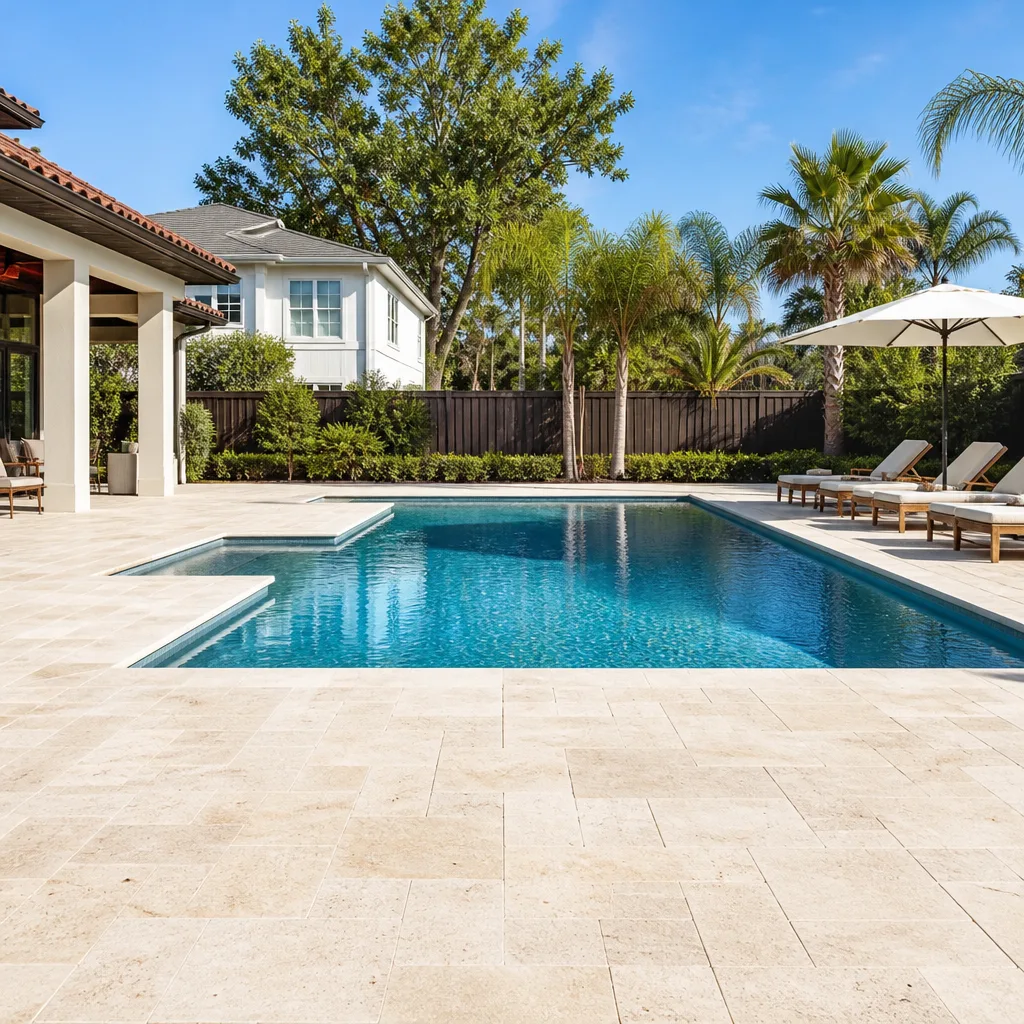
A 400 sq ft Techo-Bloc driveway in Las Vegas typically runs $7,200 to $13,600 installed, depending on product line, base conditions, and whether the old surface has to come out. Here’s where the money goes for a typical job:
| Line item | Typical range | What moves it |
|---|---|---|
| Materials (Techo-Bloc pavers) | $2,000 – $3,400 | Product line and pattern; Raffinato and Victorien sit mid-range, Bristol Valley’s large format adds waste from cuts |
| Base prep (excavation, Class II base, compaction) | $1,600 – $2,800 | Existing surface removal, how deep the dig has to go, caliche or fill surprises |
| Bedding sand, edge restraint, polymeric sand | $500 – $900 | Joint width, sand brand, edge restraint type |
| Labor (installation, cuts, cleanup) | $2,600 – $4,500 | Pattern complexity, access for a wheelbarrow vs. a skid, number of cut edges |
| Permit and inspection | $400 – $900 | Scope complexity, whether drainage changes are included |
| Sealer (optional but recommended) | $300 – $700 | Penetrating vs. film-forming; film-forming costs more and needs more frequent reapplication in Las Vegas sun |
The two numbers that move most are base prep and access. A tear-out of an old concrete apron adds excavation and haul-away. A driveway where a truck can’t back to within 30 feet means a lot of wheelbarrow time. We’ve seen both turn a $7,500 job into a $12,000 job. That’s why the written quote needs line items, not a lump: you should be able to see which of these numbers applies to your lot before you commit.
Under Clause 1 of The Haven Standard, the written price comes before any work starts. If a change comes up once we’re digging, it doesn’t happen until you sign a change order, which is the discipline that has kept our projects within a few percent of the agreed price across 4,000-plus jobs. That matters more on hardscape than almost any other trade, because base surprises are where the surprises live.
When to call a pro
If you’re replacing a failed driveway or installing a new one from scratch, the base prep is the whole ballgame and it’s the part you can’t see once the job is done. A compacted Class II base under the right depth, with the right bedding layer and edge restraint, is not a weekend project for a homeowner with a rented plate compactor. And if the existing slab sits on anything questionable, the diagnosis matters before you spend a dime on pavers.
We come out, look at the condition of the base, and tell you what we found in plain terms. If you’d like a second opinion on a quote you already have, bring it: we’ll review it line by line at no charge, per our standing Free Second Opinion offer. Related services in Las Vegas that pair naturally with a paver driveway: fence and gate work along the driveway edge, and if you’re considering an ADU with a parking apron, that’s Fence Installation in Las Vegas and Home Additions & ADU in Las Vegas territory. For the whole picture of what we do, start at the Rowan Construction Group Las Vegas home page.
The Bottom Line
- Techo-Bloc pavers hold up in Las Vegas; the specs that matter most here are different from the ones a cold climate stresses.
- Plan on sealer every 2 – 3 years, not the 4 – 5 year interval a northern installer would quote.
- Specify the manufacturer’s driveway thickness and the product line rated for it, not the patio spec.
- Use a compatible polymeric sand rated for wide joints and monsoon exposure; bargain sand washes out in one season.
- Clark County expects roughly 4 inches of compacted Class II base under a residential driveway; the bedding sand layer sits on top and is not a substitute.
- A 400 sq ft Techo-Bloc driveway in Las Vegas runs $7,200 to $13,600 installed, with base prep and access driving the spread.
The written price comes first, every time. That’s Clause 1. If you’re in Las Vegas and want a paver driveway quoted properly, Rowan Construction Group Las Vegas offers free estimates. Call (833) 467-9123 to get a flat written price with a written scope, a written warranty, a permit pulled and inspection passed, and the 365-Day Done Right Promise printed on the page. If it’s not done right, we make it right. Our technicians have up to 19 years of experience, and every visit includes a documented photo record as a standard deliverable, background-checked and uniformed technicians, and a live person answering calls.
Frequently Asked Questions
A 400 sq ft Techo-Bloc driveway in Las Vegas typically costs $7,200 to $13,600 installed. Materials run $2,000 – $3,400, base prep $1,600 – $2,800, labor $2,600 – $4,500, and the permit $400 – $900, with bedding sand, edge restraint, and sealer on top. Call (833) 467-9123 for an exact quote on your lot; estimates are free.
Every 2 – 3 years for a sun-exposed driveway. Las Vegas’s UV load and surface temperatures in excess of 160°F on a south-facing slab break down sealer faster than the 4 – 5 year interval a cooler climate would allow. Shaded patio pavers often stretch to twice that. Call (833) 467-9123 and we’ll quote the reapplication.
Roughly 4 inches of compacted Class II aggregate base for a residential driveway carrying passenger vehicles, with the paver bedding sand layer on top of that. The base is structural and the bedding sand is a leveling course, so one can’t substitute for the other. Call (833) 467-9123 and we’ll put the depth in writing before work starts.
Use the joint sand Techo-Bloc recommends for the specific product, in the compatibility family rated for wide joints and heavy water exposure. Cheap sand with a light polymer skin washes out within a season here. Call (833) 467-9123 and we’ll name the brand on the written quote.
Written by the team at Rowan Construction Group Las Vegas.
Need Construction Help?
Call Rowan Construction Group Las Vegas - licensed & insured, here with fast after-hours help in Las Vegas.
(833) 467-9123