Last updated November 18, 2026




Free written scope consultation - allowances, timeline, and change-order rules on paper before a single trade is scheduled
Driveway & Pavers Warning Signs Every Homeowner Should Know
We’ve pulled pavers from driveways where the surface looked fine and found bedding sand washed out eight inches deep. Now for the counterintuitive part: the failures that matter most on a Las Vegas paver driveway are almost entirely subsurface. By the time you see a crack, a dip, or a joint leaking sand, the base failure underneath has usually been progressing for one to two monsoon seasons. That means what you see is the last stage, not the first.
This guide covers what to look for, how to test for it, and how to tell an installer’s failure from a maintenance issue – all with an eye to the specific soils and storms of Las Vegas.
Quick Answer
Paver driveway warning signs in Las Vegas are subsurface before they’re visible. The early indicators are pavers that rock underfoot, standing water with irregular shapes after monsoon rain, joint sand dropping below a half-inch, and outward drift at the edges where the restraint has failed. Cracking and sinking are later-stage symptoms of a base that’s been failing for one to two rainy seasons. Surface appearance alone almost never tells you whether the driveway is healthy.
Styles & brands we work with
- Kitchen remodeling
- Bathroom remodeling
- Home additions & ADU
- Roofing
- Windows & doors
- Driveway & pavers
- Fence
Table of Contents
- The Rocking Test: Find Unstable Pavers Before They Spread
- What Standing Water Patterns After a Monsoon Reveal
- Joint Sand Depth: The Measurement That Tells You the Truth
- Edge Restraint Failures and How Fast They Progress
- The Driveway-to-Garage Apron Joint: Watch This Gap Closely
- Installer Fault vs. Owner Maintenance: How to Tell the Difference
- Building a Simple Inspection Log
- Why Las Vegas Climate Puts Unique Stress on a Driveway
The Rocking Test: Find Unstable Pavers Before They Spread
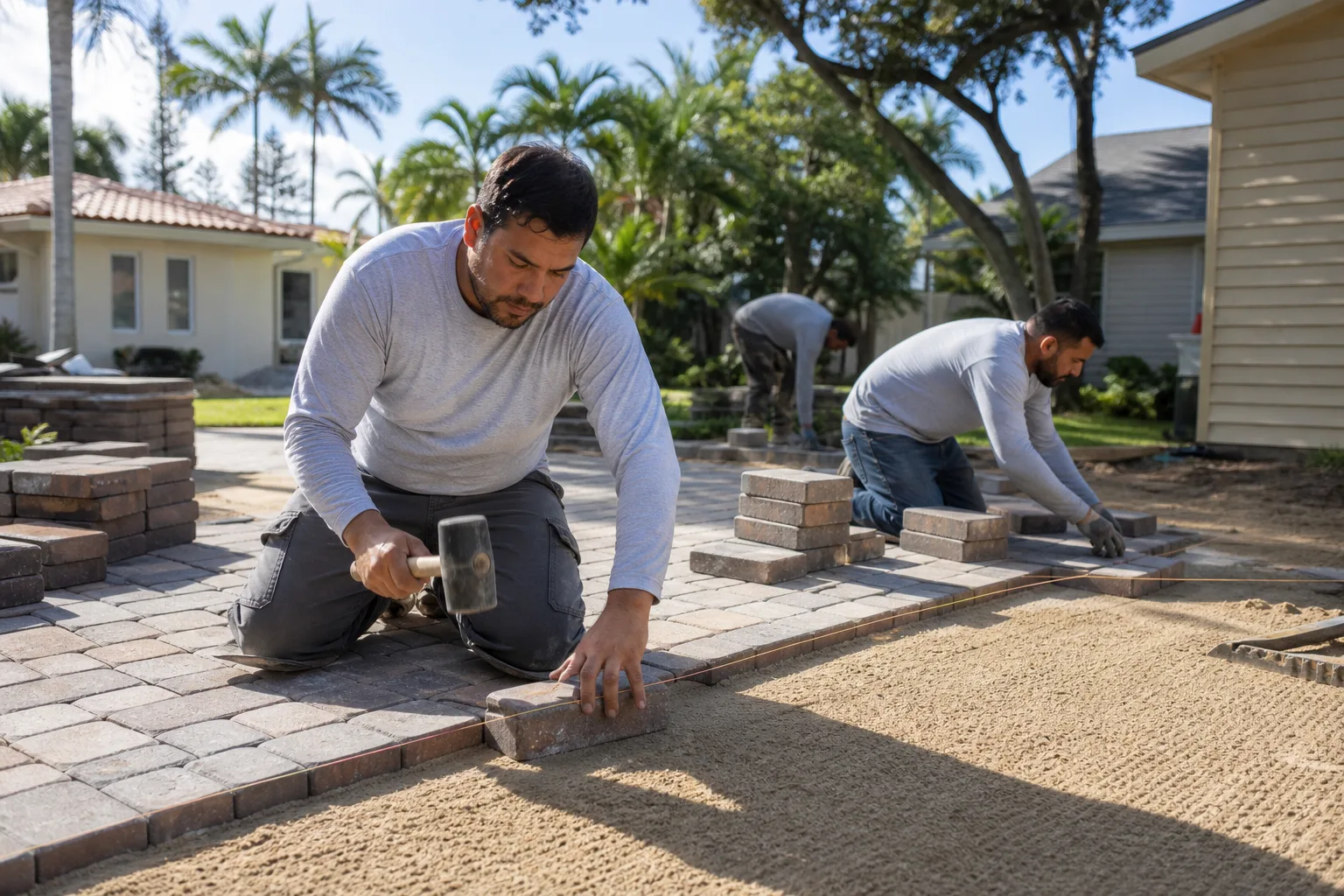
A paver that rocks slightly when you step on it is not a cosmetic problem. That movement means bedding sand is displacing under load, and every vehicle pass pulls more sand from the joint system that holds the entire field in compression. Once the interlock is broken, the failure spreads outward from that single unit, often through several adjacent pavers within one to two months.
Systematically walking your driveway once a season is the fastest way to catch problems early. Here’s how we do it:
- Start at the street edge and work inward toward the garage. Walk in a grid pattern, stepping on the center of every paver in the first two rows.
- For each paver, apply weight firmly with the ball of your foot and note any movement, however slight. Use your heel on the corners.
- Circle any rocking paver with chalk and mark the date. That single mark is a data point – one or two isolated rockers may be stable; three or more in proximity usually signal base failure beneath.
- Listen for a dull hollow tap versus a sharp sound. Hollow usually indicates a void beneath the paver.
- Photograph each marked paver with a ruler or coin in the frame for scale. This becomes evidence for a warranty conversation later.
In Las Vegas, this test is especially important after each monsoon season. The soil under many residential driveways here includes caliche – a cemented calcium carbonate layer that expands and contracts sharply with moisture, producing localized voids that your foot can feel long before the surface shows anything.
What Standing Water Patterns After a Monsoon Reveal
Standing water itself isn’t the problem; the shape and duration of the pooling tells you what’s happening under the pavers. After a monsoon cell dumps a half inch in twenty minutes, water should drain off a properly built driveway within thirty to ninety minutes. If a depression holds water for hours, the base underneath has lost grade.
Look closely at the pattern:
- Irregular or elongated pools usually indicate a localized void caused by base erosion, often where caliche pockets have collapsed. These are the most common failure after a hard monsoon in Las Vegas.
- Water pooling at the garage apron is a strong sign the base near the foundation has settled, or that the driveway was built with insufficient slope away from the structure. That one matters because water running toward the garage undermines the slab edge.
- Sheeting water that runs sideways along the driveway after rain suggests the crown has flattened, which happens when pavers shift laterally.
- Pooling at a single paver, not a larger area, usually points to that specific unit having sunk, often due to missing or depleted bedding sand under it.
After any significant storm in Las Vegas, take photos of the pooling patterns before the water drains. The shapes are evidence. Comparing a photo from June to the same spot in September tells a story no verbal description can match.
Joint Sand Depth: The Measurement That Tells You the Truth
Joint sand is the mechanism that holds a paver field in compression. Without enough sand, the pavers lose interlock and start to shift laterally. The industry-recommended fill is sand within roughly an eighth-inch of the paver’s surface, fully compacted. In practice, that means the joint depth should not exceed about a quarter-inch below the surface.
Here’s the measurement:
- Pick five joints across the driveway: one at the street apron, one in the center, one near the garage, and two at mid-field. Mix directions.
- Push a stiff ruler or a nail into the joint until it stops at compacted sand. Read the depth.
- Anything more than a quarter-inch to sand from the surface means the joint is losing material and re-sanding should be done before the next rain event.
- If the joint is empty to a depth of half an inch or more, that’s urgent. The pavers are no longer interlocked, and even moderate traffic can cause lateral shift or edge displacement.
On a Las Vegas driveway, the combination of dry heat, wind-blown dust, and monsoon runoff strips joint sand faster than in wetter climates. We typically see joints needing attention after two to three years on an exposed driveway, sometimes sooner if the homeowner is close to a desert edge or has a driveway facing direct wind. That’s the maintenance line most homeowners cross without noticing until the sunken or rocking pavers show up.
Edge Restraint Failures and How Fast They Progress
The edge restraint is the concrete or metal curb (sometimes called an edge course) that holds the entire paver field in place. It works with the joint sand to keep the pavers in compression. When the restraint fails, the whole field relaxes and starts moving outward. On most Las Vegas properties, this is the first structural failure that shows up visibly.
Signs of restraint failure:
- Spike heads visible at the edge, especially on a concrete edge restraint. The spikes that anchor the edge have lifted out of the subgrade – usually because the soil under them has eroded or dried and expanded.
- Outward paver drift at the street or side of the driveway. Pavers visible past the edge course or beyond the original straight line.
- Gaps opening at the driveway-to-garage apron joint. That horizontal seam between the paver field and the concrete apron near the garage will open up as the pavers drift outward or settle.
- Visible cracks in the concrete edge, especially near the driveway corner. Any crack means the edge is no longer doing its job.
Progression here is not slow. Once a spike lifts, the edge loses tension, and within a few weeks of normal traffic the field can move a quarter-inch or more. Multiply that across the whole driveway edge and you get visible spreading, which is almost impossible to reverse without resetting the edge.
The Driveway-to-Garage Apron Joint: Watch This Gap Closely
The joint where the pavers meet the concrete garage apron is the highest-stress point on the driveway. Water, salt from the street, and thermal movement all concentrate there. When a gap widens at this joint, the pavers have started to move away from the structure, and that’s a strong indicator that the edge restraint at the street side has failed, or the base near the structure has settled.
Measure the gap with a feeler gauge or a coin. A small seasonal gap of one-eighth inch is normal; a gap that grows from one-eighth to a quarter-inch across a single season is not. Photograph the joint every spring and fall on the same day of the month with the same reference object. That two-sample comparison tells you whether the change is ongoing, which is what matters.
A widening apron joint often teams up with other signs – drifted pavers, a slightly depressed area near the garage, or a ridge in the surface about six to eight feet out. That ridge is a heaved paver. It usually indicates base material has migrated from one area to another, which means larger repair work.
Installer Fault vs. Owner Maintenance: How to Tell the Difference
This distinction is where most homeowner disputes with a paver contractor go sideways, and it’s fixable if you build the evidence early. The general rule: if a failure traces back to how the base was built, the compaction of the base layer, or the edge restraint installation, it’s likely covered under a workmanship warranty. If it traces to joint sand depletion, drainage alterations the homeowner made, or heavy loads the driveway wasn’t designed for, it’s a maintenance issue.
The clearest way to sort it is a dated photo and inspection log. Here’s what to document:
- Photos of the surface before any work begins – even if you inherited the driveway. A move-in set of photos anchors everything that comes later.
- Date-stamped photos of any visible joint sand loss, before re-sanding. If a contractor later argues the joints were fine, your dates tell the story.
- A small written log of every observation: “March 3: paver near garage apron rocks. Marked with chalk. Joint depth measured 1/2 inch.” Two sentences per entry is enough.
- Photos after every repair, even if it was a $40 bag of joint sand. Before and after pairs are the strongest evidence that maintenance was happening on schedule.
The rule of thumb we give customers: if the same failure has appeared across a large continuous area (like a full row or a field of pavers), the cause is almost always base or edge – installer scope. If it’s scattered and concentrated near joints and edges without a clear pattern, it’s more likely sand loss that maintenance would have caught. When that line gets blurry, a Free Second Opinion on Any Written Estimate – including a warranty dispute with a prior contractor – is the cheapest way to get an independent read.
Building a Simple Inspection Log
An inspection log doesn’t need to be fancy. Use a phone note and take photos every time you do the walk-through. What matters most is the pattern over time, not the individual entry. Do the rocking test once in spring and once at the end of monsoon season – two walks a year, twenty minutes each. The log is what lets you distinguish slow movement from a fast-developing problem, and it’s the file you hand a contractor when you’re ready for a repair estimate. It also tells you when you’re crossing the line from “re-sand and move on” to “this needs the base rebuilt.”
For homes with pavers integrated into a larger exterior plan, we often recommend doing the log alongside fence and roofline checks, since water that leaves a bad driveway edge affects a fence line too. Our guide to Fence Installation in Las Vegas covers the adjacent issues to watch, and Driveway & Pavers in Las Vegas describes how the base and edge are built in the first place – the context that makes the inspection log meaningful.
Why Las Vegas Climate Puts Unique Stress on a Driveway
Three local conditions drive the failures we see most:
- Caliche soil. The cemented calcium carbonate layer common under Las Vegas lots doesn’t absorb water the way ordinary soil does. It channels runoff sideways, which erodes base layers unevenly and creates voids that show up as rocking or sunken pavers over the next season.
- Monsoon density. A storm can drop a half-inch or more in twenty minutes. The driveway surface drains fine; the base layer underneath is what takes the stress. Moisture gets in through failing joints, expands the caliche, and the base underneath compacts unevenly. That’s the mechanism that makes joint sand maintenance non-optional in Las Vegas.
- Dry-wind cycles. Between monsoons, wind-blown dust settles into joints, looking solid but often sitting loose. When the next rain hits, that loose material washes out and the joint depth can drop faster than the homeowner expects.
The takeaway: in a wetter climate, you could re-sand joint material every five or six years. In Las Vegas, we counsel a two-to-three-year cycle, with inspection after every major monsoon event. That’s not contractor upselling, it’s what the local geology and weather demand.
Common Mistakes to Avoid
- Waiting for visible cracks before investigating. By the time a crack appears, the failure under the base has been progressing for one to two monsoon seasons, and the repair scope is larger than it needed to be.
- Re-sanding without addressing the underlying void. Sand poured into a joint over a sinking base washes out again within a season. Fix the void, then re-sand.
- Assuming a single rocking paver is a single-paver problem. In a field without restraint, movement spreads. If two or three pavers rock in the same area, the base or restraint is the cause.
- Skipping photos before the failure becomes serious. A dated photo taken before a small repair is the most valuable document in any warranty conversation – and it’s free.
- Changing drainage around the driveway without updating the paver base. Landscaping changes that redirect water are a common cause of caliche-related erosion in Las Vegas. If you add a retaining wall, tree, or downspout near the driveway, re-inspect the edge afterward.
- Using sand blowers or pressure washers at full power on joints. Both can strip compacted joint sand quickly. Light pressure wash and a hose are enough for routine cleaning.
- Assuming the installer’s warranty covers everything. Most workmanship warranties cover installation, not maintenance. Read the scope and keep the log current.
See the difference
 Before
 After
 Before
 After
 Before
 After
When to Call a Professional
Some of these signs you can handle yourself: re-sanding joints, spot-checking for rockers, taking photos. Others need a contractor with the right compaction equipment and the right understanding of the base layer. Call us when any of these are true:
- Pavers are rocking across an area larger than two or three adjacent units.
- The edge restraint is visibly failing (lifted spikes, outward drift).
- The driveway-to-garage apron joint has widened by a quarter-inch or more across a season.
- Water has pooled for more than a few hours after a storm and doesn’t drain.
- You’re in a warranty dispute and need an independent read on the scope.
Rowan Construction Group Las Vegas offers free estimates in Las Vegas – call (833) 467-9123. We’ll come out, walk the driveway, and give you a written price with a written scope before any work starts. Under the Haven Standard, no work proceeds until the price is signed – and there are no change orders without your signature on file. If your home is also ready for a broader exterior update, our Home Additions & ADU in Las Vegas team coordinates with driveway work when the driveway abuts new construction. You can see the full trade list on our Rowan Construction Group Las Vegas home page.
Frequently Asked Questions
The fastest sign is a paver that rocks underfoot for no obvious reason. If two or three adjacent pavers rock, or the rockers persist through a full season without settling, the base underneath has likely lost compaction or has a void. Combine the rocking test with the standing-water pattern after a storm – irregular pooling plus rockers is a strong indicator the base is the cause.
Sand should fill the joint to within an eighth to a quarter-inch of the paver surface, fully compacted. If you push a nail into the joint and it drops half an inch or more before hitting compacted material, that joint is failing and re-sanding is urgent. Sand that has washed away by monsoon runoff is common in Las Vegas because of how fast water flows across a hot, dry surface.
The shape of the pool tells you where the base has eroded. Irregular, elongated pools usually mean base failure, especially where caliche pockets have collapsed under the pavers. Water pooling against the garage apron signals a settling issue near the slab. Take photos of these patterns before the water drains; comparing them across seasons is the clearest evidence you can collect.
Caliche is a dense calcium-carbonate layer common under Las Vegas soil. It expands and contracts sharply with moisture, and it channels water sideways instead of absorbing it evenly. That produces localized erosion in the paver base, particularly where joints are depleted. Re-sanding joints and confirming the driveway crown are the two most effective ways to slow caliche damage.
Usually maintenance. Joint sand loss from traffic, weather, and runoff is not typically covered under workmanship warranty, so a dated photo log is your best protection when you’re tracking whether the failure is ongoing maintenance or a base problem. If a large area of pavers is moving together, or edge restraint is failing, that’s a stronger candidate for warranty review. Call (833) 467-9123 for a free second opinion, and we’ll walk the driveway with you at no charge.
Two to three years is typical in Las Vegas, sometimes sooner on driveways facing direct wind or near desert edges. After every major monsoon, check joint depth in five spots across the driveway. If the sand has dropped below a quarter-inch, re-sand before the next storm to keep the interlock intact.
The Bottom Line
The warning signs on a Las Vegas paver driveway are almost entirely subsurface: rocking pavers, standing water with irregular shapes after a monsoon, joint sand below a quarter-inch, edge restraint failures, and a widening apron joint. By the time surface cracks or visible sinking appear, the base failure has been progressing for one to two rainy seasons. The fixes that prevent an expensive rebuild are simple and cheap: walk the driveway twice a year, keep dated photos, re-sand on a two-to-three-year cycle, and get a professional read when rockers spread or the edges start to drift.
If something in the list above sounds familiar, or if you just want a second opinion on a problem a previous contractor left you with, call Rowan Construction Group Las Vegas at (833) 467-9123 for a free estimate. Every driveway estimate comes with a written price, a written scope, a photo record of what we found before any work starts, and the 365-Day Done Right Promise behind the finished result. Bring a competitor’s estimate if you have one – our free second opinion reviews it line by line, no obligation.
Written by the team at Rowan Construction Group Las Vegas.